Thinking out
loud.
Notes from the intersection of business, creativity and technology. Perspectives, experiments and the occasional question worth sitting with.
Ideas about intelligent systems, the craft of fine-tuning open models, and the choices behind useful technology.
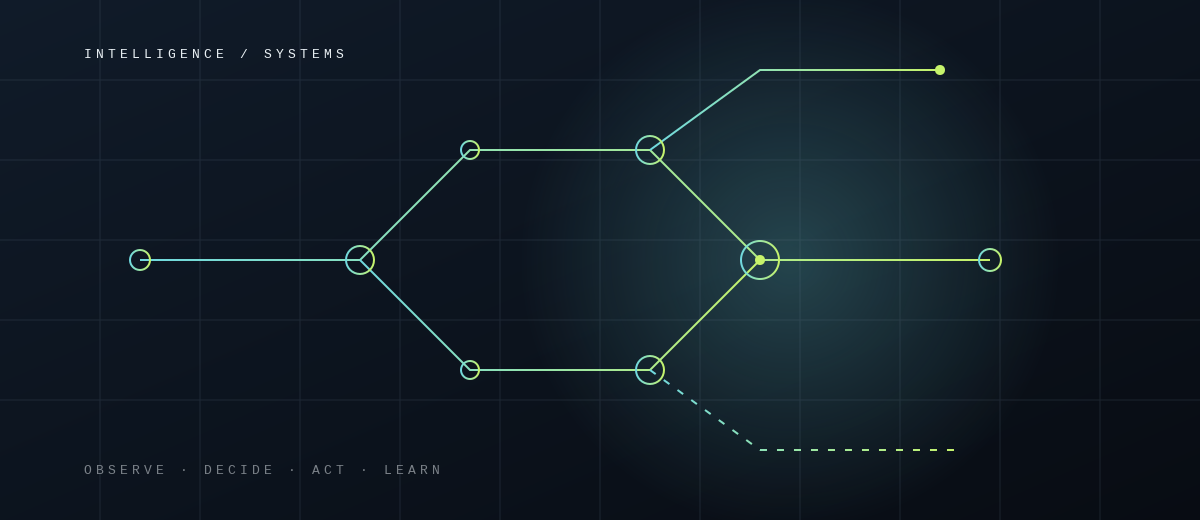
Building AI Agents for the Future
The next leap is not another chatbot. It is a system that understands a goal, uses tools, remembers what matters, verifies its work and knows when to stop.
READ ARTICLE ↗Repetitive Workflows Do Not Lead to Specialisation
Automation can make a process faster without making an organisation better. Specialisation begins when a system learns from exceptions, judgement and outcomes.
READ ARTICLE ↗Looping Memory with Evolving Algorithms: What Do Prime Numbers Have to Do With It?
A thought experiment about memory, recurrence and prime numbers — and why a system that remembers everything may be less intelligent than one that knows what to revisit.
READ ARTICLE ↗Why Is AI Solving Unsolved Equations?
AI is beginning to contribute to mathematics and scientific discovery — but the story is a new partnership between pattern-finding, computation and proof.
READ ARTICLE ↗Are You Using AI the Way It Should Be Used?
Three people can open the same model, write the same prompt and receive different value. The advantage is choosing the right model, context and workflow for the decision.
READ ARTICLE ↗
Unsloth, Fine-Tuning and the Question of Making a Model Your Own
Fine-tuning is a disciplined way to adapt a capable base model to a more specific behaviour, format or task — and Unsloth makes that experimentation more accessible.
READ ARTICLE ↗Setting Up Unsloth: From Installation to Your First Model
A practical first-run checklist: validate the hardware and environment, choose a supported model, run a known-good example and save a baseline before changing anything.
READ ARTICLE ↗LoRA, QLoRA or Full Fine-Tuning: What Should You Actually Use?
Three approaches, three resource profiles. The right choice depends on the task, hardware, precision requirements and how much of the original model you really need to change.
READ ARTICLE ↗The Dataset Is the Teacher: Preparing Examples and Chat Templates
A training run can be technically perfect and still teach the wrong lesson. Good fine-tuning begins with clean examples, a consistent schema, the correct chat template and an honest evaluation set.
READ ARTICLE ↗Training Your First Specialised Model: Experiments, Parameters and Evaluation
A disciplined training loop is more valuable than a lucky result. Establish a baseline, change one variable at a time, watch for overfitting and test on unseen examples.
READ ARTICLE ↗From Trained Model to Usable Product: Exporting, Running and Deploying
A trained adapter is not yet a product. Export formats, inference engines, quantisation, licences, testing and safeguards determine whether a model can be used reliably.
READ ARTICLE ↗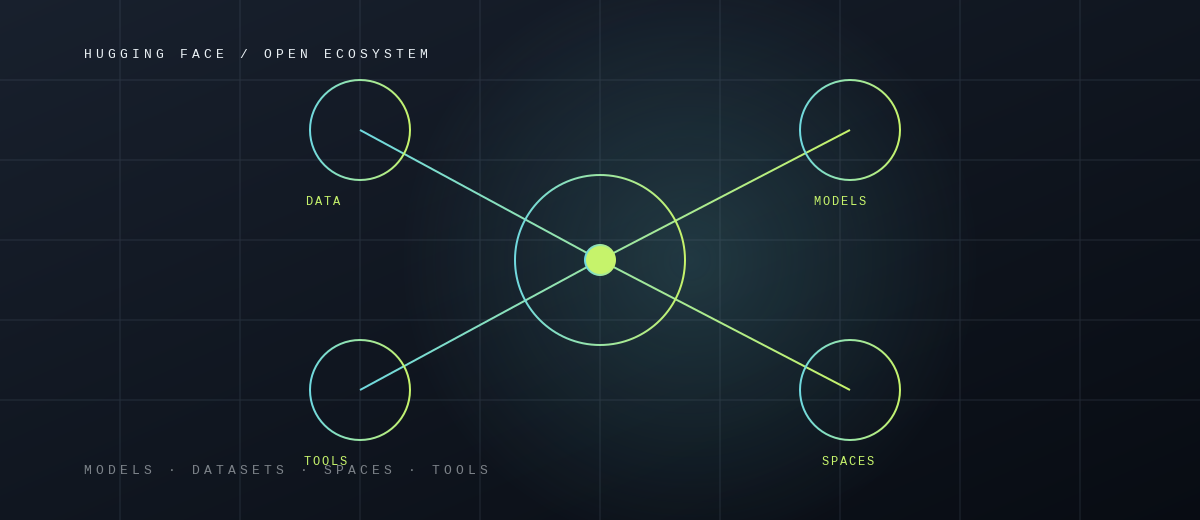
Hugging Face: Understanding the Open Model Ecosystem
Hugging Face is more than a place to download model weights. It is an ecosystem of models, datasets, applications, libraries, evaluation information and builders.
READ ARTICLE ↗How to Read a Hugging Face Model Card Before You Download a Model
A model card is your first due-diligence document: task, architecture, licence, intended use, limitations, training details and evidence.
READ ARTICLE ↗Base, Instruct, Reasoning and Coder Models: What Is the Difference?
Model labels describe different training histories and intended behaviours, not a universal ranking. Understand the distinction before choosing one.
READ ARTICLE ↗Parameters, Context Windows, Tokenizers and Quantisation — Without the Jargon
Four technical terms shape what a model can do, how much hardware it needs and how it handles your input. Understanding them beats comparing model sizes alone.
READ ARTICLE ↗Beyond LLMs: Vision, Audio, Embeddings and Multimodal Models
Artificial intelligence is not just text generation. Image understanding, audio, speech, embeddings and multimodal models open very different ways to build useful systems.
READ ARTICLE ↗Choosing the Right Hugging Face Model: Benchmarks Versus Real-World Performance
A benchmark is a useful signal, not a substitute for testing. The right model is the one that performs on your workload within your latency, cost, privacy and reliability requirements.
READ ARTICLE ↗