There was a time when finding an AI model meant finding a paper, locating a repository and trying to work out whether the code and weights could actually be used.
That process has become much more accessible.
Hugging Face has helped turn open machine learning into an ecosystem where people can discover, share and use models, datasets and applications. Its Hub is often the first stop for anyone experimenting with language models, vision, audio or multimodal systems.
But the Hub is not simply an app store for AI.
Three building blocks
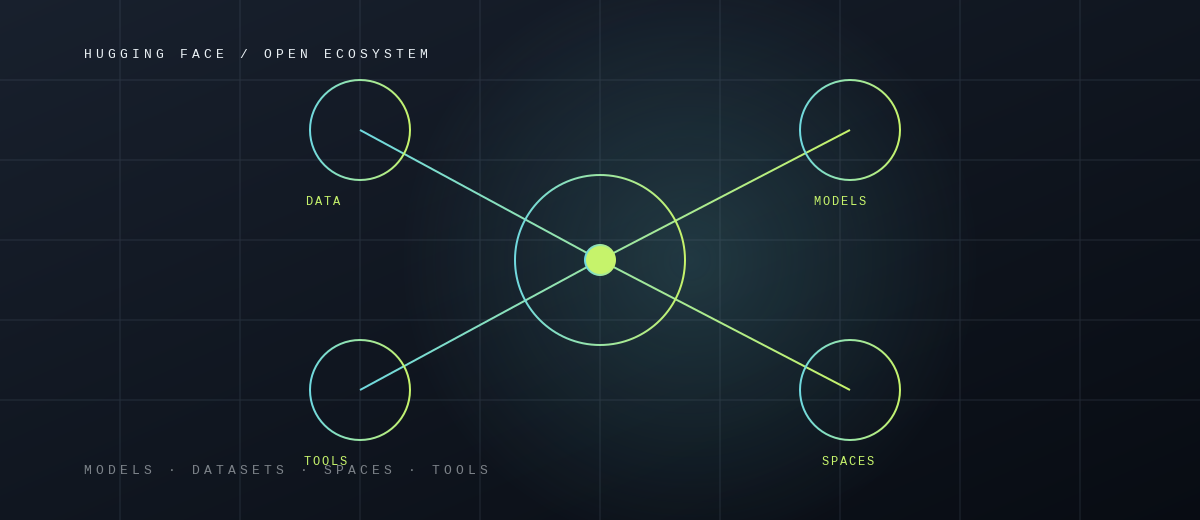
The easiest way to understand the ecosystem is to start with three kinds of repositories.
Models contain model files and the metadata, configuration and documentation needed to understand and use them. A repository may include weights, a tokenizer, a configuration file and a model card.
Datasets contain the data used for training, evaluation or other machine-learning tasks. Dataset documentation matters because the name alone rarely tells you what the data contains, how it was collected or what its limitations are.
Spaces are a way to host and share interactive machine-learning applications. They make it easier to demonstrate a model or connect different components into an experience.
Around these are libraries and tools such as Transformers, Datasets, Tokenizers, Accelerate and the Hugging Face Hub client. They make the ecosystem more than a directory of files.
Discovery is not the same as due diligence
A model appearing high in search results does not mean it is the right model for a project.
Before downloading anything, look at the model card, licence, architecture, task, supported languages, training data description and evaluation results. Check whether the weights are actually available, whether they are in a format your runtime supports and whether there are known limitations.
The same applies to datasets. A useful dataset is not simply large. Its provenance, licence, distribution and intended use matter.
The Hub helps surface this information, but the responsibility to assess it remains with the person or organisation using the repository.
An ecosystem for experimentation
This is useful because AI development is no longer one discipline.
Motion Falcon's creative-technology explorations may involve a language model for planning, a vision model for image understanding and an image-generation workflow for visual experimentation. The Hub makes it easier to discover specialised components rather than assuming one model can do everything.
For Rhythence, the relevant ecosystem could include language models, embedding models and datasets used to evaluate information extraction or classification. Sensitive operational information needs careful governance; public model repositories are not a substitute for private data controls.
Webdais introduces speech and audio into the picture. Models for speech recognition, synthesis and audio understanding can be explored alongside conversational systems, although the intended architecture and real-time requirements still matter.
These are examples of where the ecosystem can support exploration, not a claim that a repository is production-ready simply because it is accessible.
Open does not mean unrestricted
“Open” is used in different ways across AI. A repository may publish weights but impose restrictions in its licence. A model may be downloadable but not reproducible because parts of the training process are undisclosed. Some models are open source in a stricter sense; others are better described as open-weight.
Read the terms, not only the label.
Also consider security. Prefer well-understood weight formats and follow the library's guidance when loading model files. The Hugging Face model release checklist recommends formats such as Safetensors for weight distribution rather than relying on pickle-based serialization.
Explore the Hugging Face Hub, then open the documentation for the relevant Hub features. Choose one task, one model and one evaluation set. Learn how the repository is structured before trying to build an entire pipeline.
Hugging Face makes the open model ecosystem easier to explore. Good engineering begins when exploration is followed by inspection, testing and responsibility.